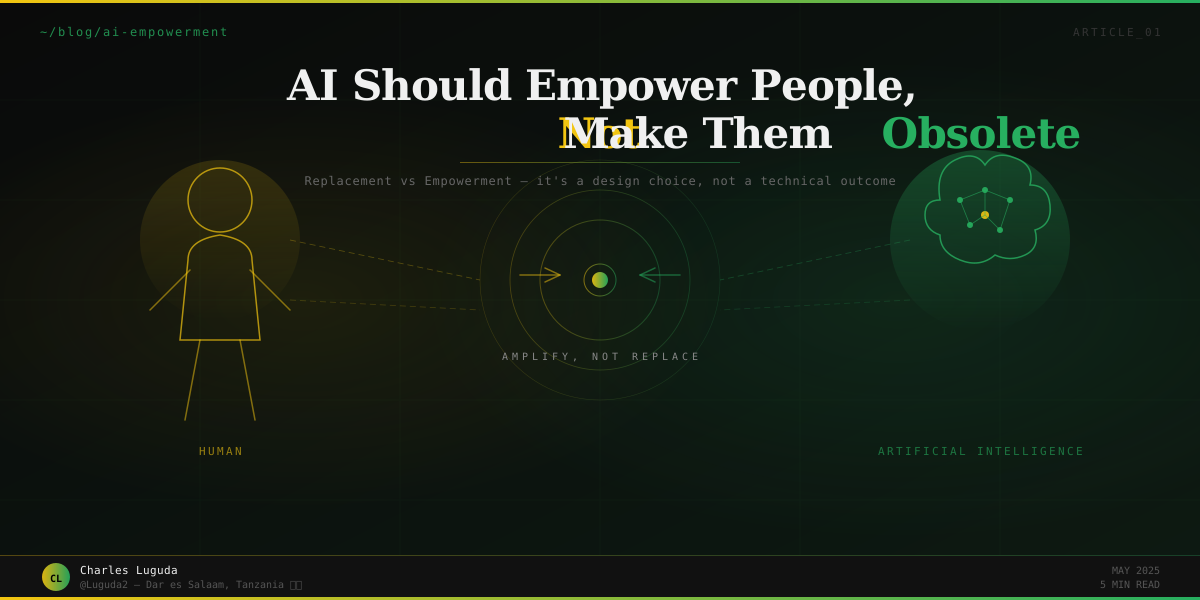
There is a version of the future where AI lifts billions of people out of limitation — where a farmer in Tanzania can access expert agricultural advice instantly, where a student in Lagos can learn from the best teachers in the world, where a small business owner in Nairobi can compete with corporations twice their size.
That version is possible. But it is not the version we are currently building.
Right now, the dominant conversation around AI is about replacement. How many jobs will disappear? How many industries will be disrupted? How many people will become unnecessary? And while Silicon Valley frames this as inevitable progress, the people asking those questions are rarely the ones who will suffer the consequences.
The Productivity Trap
AI is making companies more productive. That is not in dispute. But productivity gains and human prosperity are not the same thing.
When a company uses AI to do the work of ten people and lays off eight of them, productivity goes up. But eight families lost their income. The value created by that AI did not flow to the workers — it flowed to the shareholders.
This is not a new problem. It is the oldest problem in capitalism. But AI is accelerating it at a speed that policy, education systems, and labor markets cannot keep up with. And in developing economies, the gap is even wider — because the safety nets are thinner, the retraining pipelines barely exist, and the majority of jobs being threatened are not knowledge jobs. They are the jobs that millions of ordinary people depend on every single day.
Why This Matters More in the Global South
In wealthier countries, when a job disappears, there are systems — unemployment benefits, retraining programs, social safety nets — that slow the fall. They are imperfect, but they exist.
In most of Africa, those systems are either weak or absent. A driver who loses work to autonomous vehicles, a call center agent replaced by a chatbot, a junior accountant made redundant by automation — these are not people with six months of savings and a government cushion. These are people whose families depend on that income today.
AI is largely being built by wealthy countries, for wealthy countries, optimizing for problems that wealthy people have. That is a dangerous imbalance.
And yet almost nobody building AI is thinking about them. The datasets are not built around them. The tools are not designed for them. The access is not priced for them.
Empowerment Is a Design Choice
Here is what is important to understand: AI does not have to work this way. Replacement versus empowerment is not a technical outcome — it is a design choice.
The goal is not to replace human agency, creativity, judgement, or purpose — it is to amplify them, so we can achieve more, faster, and with greater freedom.
A doctor with AI can diagnose faster, treat more patients, and make fewer errors. The doctor is not replaced — they are amplified. A teacher with AI can personalize learning for every student in a class of forty. A small business owner with AI can write better proposals, manage inventory smarter, and market more effectively — competing in spaces that were previously closed to them.
The difference between these outcomes and the destructive ones is not the technology. It is the intention behind how it is built and deployed. It is who is in the room when the decisions are made. It is whether the people most affected by AI have any voice in shaping it.
What Needs to Change
AI companies need to measure success differently. Profit margins and benchmark scores are not enough. The question that should sit alongside every AI product launch is: who does this leave behind, and why?
Governments in the Global South need to engage with this seriously — not reactively, after the disruption has already happened, but now. Workforce development, digital literacy, and access to AI tools need to be treated as infrastructure, the same way roads and electricity are infrastructure.
And those of us building with AI — developers, founders, creators — carry a responsibility too. The tools we build either widen the gap or narrow it. That choice belongs to us.
The Fear Worth Taking Seriously
The optimists say AI will create more jobs than it destroys. Maybe. But that argument offers very little comfort to someone whose job disappears next year while the new jobs arrive in a decade, in a different city, requiring skills they were never given access to learn.
The fear is not that AI will fail. The fear is that it will succeed — and that its success will be enjoyed by a very small number of people while the rest of the world watches from the outside.
That outcome is not inevitable. But avoiding it requires us to care about it now, before the patterns are locked in and the decisions are already made.
The healthier path is augmented intelligence — AI as a force multiplier for human strength. Companies building tools that make good workers exceptional, rather than making humans optional. Education systems where AI personalizes learning but humans still provide meaning, taste, and moral framing. A world where the gains don't just flow upward.
AI should make us more human — more capable, more creative, more free. That is still possible. But only if we choose to build it that way.